How to build a recurring host who looks the same in every video
Building consistent characters across your video series on AwakeVerse
Anyone who has made more than one AI video has run into the same wall. You generate a host you love on Monday. You come back Wednesday to make the next episode, write a similar prompt, and out comes… someone else. Same vibe, different face. Different jaw, different hair, a nose that migrated. For a one-off clip that's fine. For a show — a series with a host your audience is supposed to recognise — it's fatal. Consistency isn't a nice-to-have; it's the entire premise of a recurring character.
The usual workarounds are all compromises. Reuse one frozen clip forever and your host can never do anything new. Re-prompt every time and pray. Hand-edit each result. None of them scale past a couple of episodes, and none of them give you the thing you actually want: the same person, doing new things, across an open-ended run of videos.
The fix is a small idea applied strictly: lock the look once, then reuse it — never regenerate it. That's what cast-locking does, and it's how AwakeVerse turns "AI characters drift" into "your host looks the same in every episode."
The plate: one canonical look, captured once
When you first build a character, AwakeVerse creates a reference plate — a single, clean portrait that becomes that character's canonical look. It isn't a frame from the video; it's the anchor every shot is generated from. The moment your first episode renders, that plate is locked to the series.
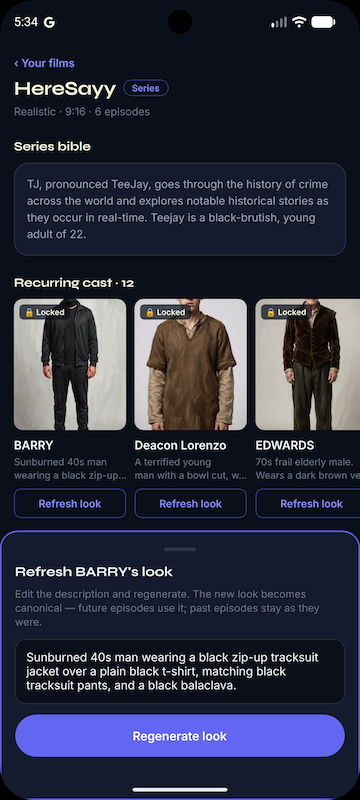
That locking is the whole trick. From then on, the character isn't described-and-hoped-for each time — they're referenced. Every new shot is composed from the locked plate, so the face, hair, and build carry over intact. You're no longer re-rolling a dice and hoping it lands on the same person; you're pinning the person and moving the camera around them.
Reuse by name, across every episode
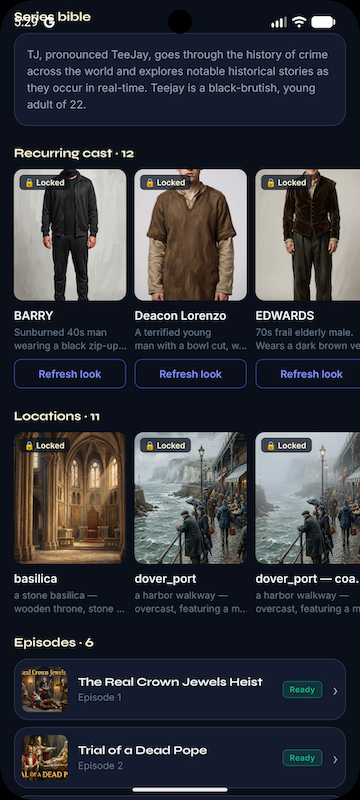
Once a character is locked, adding the next episode doesn't reintroduce them — it reuses them. Write "the host walks into the studio," and the host who walks in is the exact host from episode one, because the series remembers them by name and pulls their locked plate forward automatically. New characters can join as the story grows, but the returning ones never drift.
The same principle covers locations.
A recurring set — the studio, the kitchen, the office — gets locked the first time it appears and is reused whenever the script returns to it. So it isn't only your host who stays consistent; it's the whole world the show lives in.
Deliberate change, when you actually want it
Consistency shouldn't mean your host is frozen forever. Sometimes you want a change — a new outfit for a special, a character who ages across a time-skip. The point is that change should be a decision you make, not an accident the model hands you.
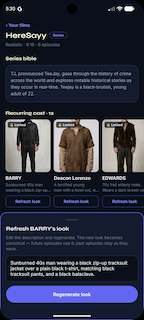
That's what "Refresh look" is for. It edits the character from their current locked plate — same identity, updated wardrobe or age — and re-locks the new look going forward. Crucially, it only affects future episodes; everything you've already rendered keeps the look it had. So a wardrobe change or a time-skip becomes a clean, intentional edit rather than an identity that quietly slips between episodes.
The consistency promise, made practical
Put together, the workflow is almost boringly simple — which is the point:
Start a series and build Episode 1 the way you'd build any video.
Approve the cast. The look you approve is captured as each character's plate.
Render. That first render locks the cast and any recurring locations to the series.
Add episodes. Returning characters and sets are reused automatically — same faces, same places.
Refresh a look only when you deliberately want one to change.
You can also take a finished one-off film and promote it into a series — its cast gets locked exactly the same way, and it becomes Episode 1 of an ongoing show.
"AI characters are consistent now" is the kind of promise that's easy to say and hard to keep. Cast-locking is what makes it real: not a lucky prompt, not a frozen clip, but a canonical look that's captured once, reused by name, and changed only on purpose. That's the difference between generating videos and building a show — a host your audience recognises the moment they appear, in episode one and episode fifty alike.